In today’s industrial landscape, the push towards a circular economy is no longer a niche concept but a commercial imperative. For manufacturers and processors across the USA and Europe, transforming waste streams into valuable secondary raw materials is key to enhancing sustainability, complying with regulations, and unlocking new revenue channels. The engine driving this transformation is the modern waste recycling machine.
But what happens after a batch of mixed plastic, metal, or electronic waste is collected? How does a complex, often contaminated, stream of material become uniform, high-purity feedstock ready for re-manufacturing?
The answer lies in a sophisticated, multi-stage process engineered for precision, efficiency, and robustness. At Máquina Rumtoo, we specialise in designing and building these integrated systems. This guide will demystify the technology, breaking down the step-by-step journey of waste as it travels through a state-of-the-art recycling line. We will explore the core components, their functions, and how they combine to deliver results that power modern industry.
What is a Waste Recycling Machine? More Than a Single Unit
First, it is crucial to understand that an industrial “waste recycling machine” is rarely a single piece of equipment. Instead, it is a complete system or production line—a series of specialised machines working in concert to achieve a specific outcome. The configuration of this line is meticulously tailored to the type of input material (the “infeed”) and the desired quality of the output product.
These systems can be broadly categorised by the materials they are designed to process, such as:
- Plastics Recycling Lines: For processing post-industrial or post-consumer plastics like PET, HDPE, PP, and film.
- Metal Recycling Systems: For sorting and processing ferrous (iron, steel) and non-ferrous (aluminium, copper) metals.
- E-Waste (WEEE) Processing Plants: For dismantling and recovering valuable components from discarded electronics.
- Tyre Recycling Lines: For shredding and separating rubber, steel, and fibre from end-of-life tyres.
The ultimate goal of any system engineered by Máquina Rumtoo is to execute three core tasks with maximum efficiency: liberation (breaking items down), separation (sorting the different materials), and purification (cleaning and preparing for reuse).
The Heart of the System: Main Components of a Recycling Line
A typical industrial recycling line is a testament to mechanical, magnetic, and optical engineering. While the exact configuration varies, the following core components are fundamental to most high-performance systems.
1. Infeed & Conveying Systems
The journey begins here. Waste material is loaded onto heavy-duty conveyor belts. These are not simple transport mechanisms; they are designed to handle abrasive, heavy, and irregularly shaped materials while providing a steady, controlled flow of material to the next stage. A consistent feed rate is critical for the efficiency of the entire line.
2. Size Reduction (Shredders & Granulators)
This is the “liberation” stage. For materials to be sorted effectively, they must first be broken down into smaller, more uniform pieces.
- Primary Shredders: These powerful, high-torque machines are the workhorses of the line. Single-shaft or four-shaft shredders use slow-rotating knives to tear apart bulky items—from baled plastic bottles to car parts. This initial shred creates a coarse, manageable fraction.
- Granuladores: After initial shredding and some sorting, a granulator (or secondary shredder) may be used for further size reduction. These high-speed machines use sharp, angled blades to chop the material into small, consistently sized flakes or “regrind,” typically 10-12 mm in size.
3. Sorting and Separation Technology
This is where the magic happens and where the value is truly created. A multi-stage separation process is essential to achieve the high purity levels required by today’s markets.
- Magnetic Separators: The simplest and most effective method for recovering steel and other ferrous metals. Powerful overhead belt magnets or magnetic drums are positioned over the conveyor, lifting the ferrous materials out of the waste stream.
- Eddy Current Separators (ECS): To separate non-ferrous metals like aluminium and copper, an ECS is used. It employs a high-speed rotating magnetic rotor to induce “eddy currents” in the conductive metal particles, effectively repelling them and throwing them forward onto a separate conveyor, while other materials like plastic and rubber simply fall off the end.
- Sink-Float Tanks (Density Separation): This method uses the simple principle of density. Material is fed into a large tank of water. Materials with a density lower than water (like PP and PE plastics) will float, while denser materials (like PET plastic, PVC, and residual metals) will sink. Paddles and conveyors skim the top and dredge the bottom to separate the two streams.
- Optical Sorters (NIR Technology): This is the pinnacle of modern sorting. As material passes at high speed on a conveyor, Near-Infrared (NIR) sensors scan each piece, identifying its unique material signature based on how it reflects light. If a sensor detects a target material (e.g., a PET bottle in a mixed plastic stream), it signals a bank of precision air jets to blast that specific item onto a different path. Systems from Máquina Rumtoo can incorporate optical sorters capable of achieving over 99% purity rates.
4. Washing and Cleaning Line
Purity is not just about material type; it’s also about cleanliness. Contaminants like dirt, labels, glue, and food residue will ruin a batch of recycled material. A robust washing line is non-negotiable, especially in plastics recycling.
- Arandela de fricción: A high-speed screw washer that scrubs the material with water to remove stubborn dirt and labels.
- Hot Wash System: For food-grade applications (like bottle-to-bottle recycling), a hot wash with caustic soda is used to sterilise the material and dissolve glues completely.
5. Drying System
Before the final processing stage, all moisture must be removed. Efficient drying prevents issues in extrusion and saves energy.
- Mechanical Dryer (Centrifugal): A high-speed centrifuge spins the material, forcing water out through a screen. It’s an energy-efficient first step.
- Secador térmico: A stream of hot air is passed through the material as it tumbles, removing any remaining moisture to achieve a final moisture content of less than 1%.
6. Pelletising / Densification
For many applications, especially in plastics, the final step is to convert the clean, dry flakes into uniform pellets. An extrusora melts the plastic flakes and pushes them through a die to form spaghetti-like strands. These strands are instantly cooled in a water bath and cut by a rotating knife, creating uniform pellets that are easy to handle, transport, and use in manufacturing equipment like injection moulders.
Visualising the Flow: Step-by-Step Working Process
To bring these components together, let’s trace the path of a mixed bale of plastic bottles through a state-of-the-art Máquina Rumtoo recycling line.
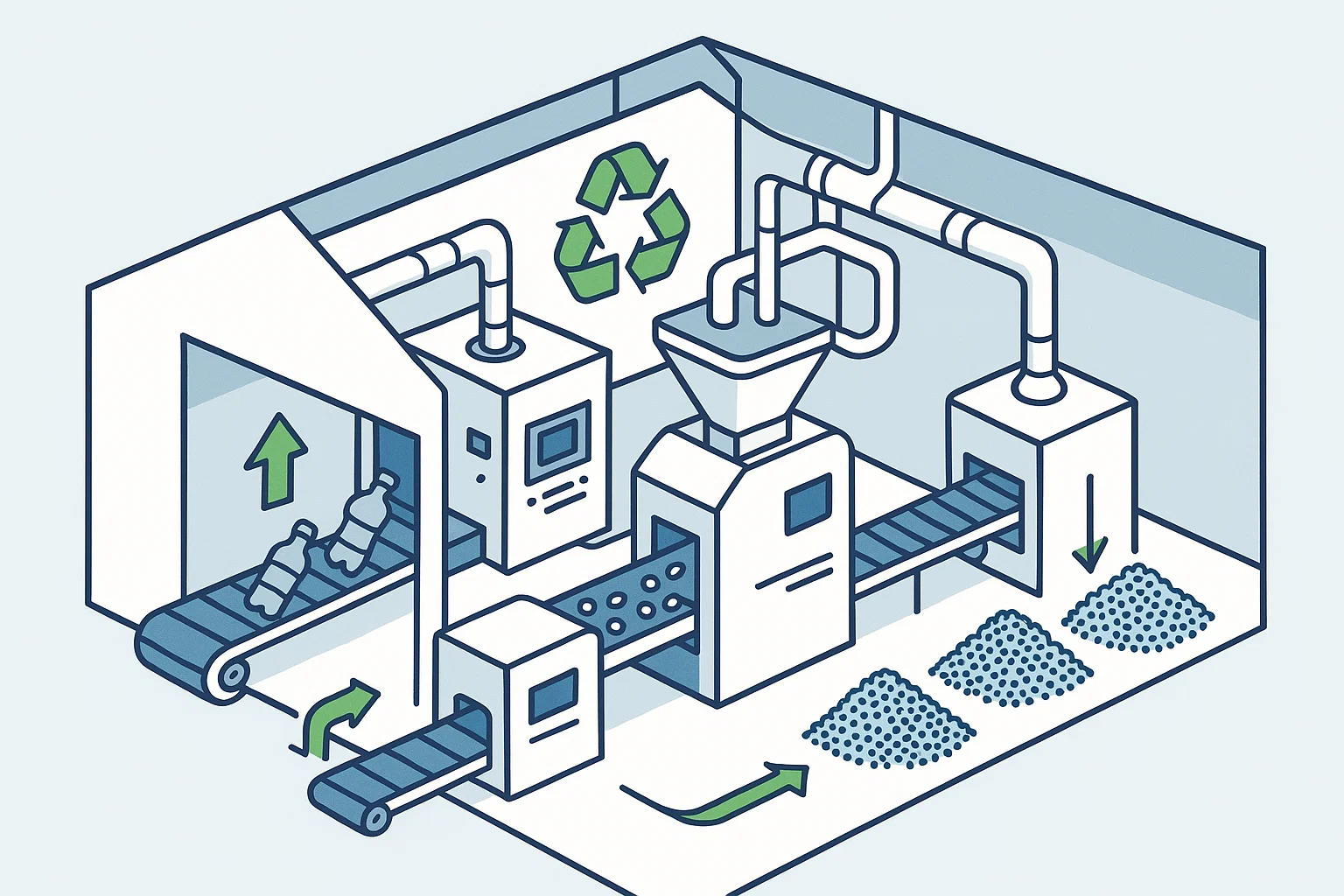
- Infeed: The bale is broken apart and fed onto the main conveyor.
- Pre-Sorting: A manual sorting station may be used to remove any large, obvious contaminants (e.g., large metal pieces, wood).
- Primary Shredding: The bottles are shredded into coarse 40-60mm pieces.
- Metal Separation: The stream passes under a magnetic separator to remove any steel caps or rings, followed by an eddy current separator to eject aluminium.
- Density Separation: The mixed plastic shred enters a sink-float tank. PET flakes sink, while HDPE and PP caps and labels float. The two streams are now separate.
- Washing & Drying: The PET stream moves to a friction and hot wash line to remove all glue and residue, followed by mechanical and thermal drying.
- Optical Sorting: The clean, dry PET flakes are passed through an optical sorter to remove any remaining coloured plastics or contaminants, achieving bottle-grade purity.
- Pelletising: The purified PET flakes are fed into an extruder and converted into high-quality, uniform pellets.
- Bagging: The final pellets are stored in large silo bags, ready for shipment to a manufacturer.
Diagram: A Typical Plastic Recycling Workflow
Tailored Solutions: Applications by Industry
The true power of modern recycling machinery lies in its adaptability. A system isn’t one-size-fits-all.
- For Plastics Manufacturers: The focus is on producing high-purity, consistent-quality regrind or pellets from post-industrial scrap or post-consumer feedstocks. This material can be fed directly back into injection moulding or extrusion lines, closing the production loop and significantly reducing raw material costs.
- For Metal Recyclers: The goal is maximum separation and recovery. A robust Máquina Rumtoo system for a scrapyard will focus on powerful shredders to liberate materials, and highly efficient magnetic and eddy current separators to sort clean ferrous and non-ferrous streams that command the highest prices from smelters.
- For E-Waste Processors: These are among the most complex systems, requiring careful manual dismantling followed by automated shredding and sophisticated separation to recover precious metals (gold, palladium), common metals (copper, aluminium), and various types of plastics, all while safely handling hazardous components.
Choosing the Right System: Expertise Matters
As this guide illustrates, a waste recycling machine is a complex and powerful system. The success of a recycling operation hinges on having a line that is not only built with high-quality components but is also intelligently designed and integrated for a specific feedstock and desired output.
Investing in the right technology is an investment in efficiency, profitability, and sustainability. The throughput, uptime, and purity of the final product are all directly tied to the engineering expertise behind the system.
Preguntas frecuentes (FAQ)
1. What types of waste can Rumtoo Machine systems process?
We design and manufacture systems for a wide range of materials, including all major types of plastics (PET, HDPE, LDPE, PP, PVC), ferrous and non-ferrous metals, e-waste (WEEE), tyres, paper and cardboard, and more. Each system is custom-engineered for the specific application.
2. How do you ensure the final recycled material is of high quality?
Quality is our primary focus. We achieve it through a multi-stage process of sorting, cleaning, and purification. By integrating advanced technologies like multi-stage washing, density separation, and high-precision optical sorters, we can design systems that meet the stringent purity standards required for re-manufacturing, often exceeding 99% purity.
3. What is the typical footprint for a complete industrial recycling line?
The space requirement varies significantly based on the system’s complexity and throughput. A simple, low-capacity line might fit in a few hundred square metres, while a high-volume municipal sorting facility can span several thousand. During our consultation process, we provide detailed layout plans optimised for your available space.
4. What is the return on investment (ROI) for a recycling system?
The ROI is compelling and is driven by several factors: revenue from selling the high-purity recycled materials, significant savings on raw material costs by reusing scrap internally, reduced landfill disposal fees, and compliance with environmental regulations. We work with clients to create a detailed business case based on their specific operational data.